
|

|


Measuring weather
Upper air measurements - tethersondes, dropsondes & driftsondes
 A tethersonde can be thought of as a portable tower of meteorological
instruments. It consists of a series of instruments suspended at specified
intervals by a balloon to measure meteorological features in the
planetary boundary layer. A benefit
is that they provide continuous data regarding the lower troposphere, rather
than a single snapshot.
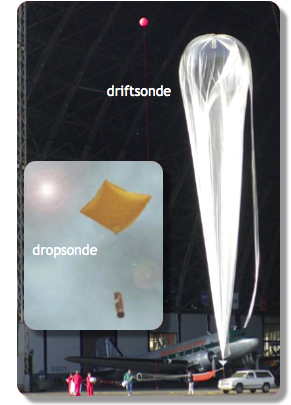
A dropsonde is a radiosonde that is dropped from aircraft. Instead of a balloon,
they are attached to a parachute to slow the rate of descent. They are most
often used in locations where it may be unsafe to be on the ground for a
radiosonde launch, like in a hurricane. They have been instrumental in
improving hurricane forecasts. Dropsondes have also been delivered to other
planets by spacecraft including both Venus and Jupiter!
Related to dropsondes are driftsondes. These craft consist of VERY LARGE
balloons that climb to the lower stratosphere, around 60,000 to 65,000 feet, and
float freely with the wind for a week or longer.
While capable of making observations themselves, they also often carry a
dropsonde payload to be deployed when scientists on the ground send a signal to
it. Features of interest include tropical storms and very remote regions that
are typically poorly observed.
Next page
->
in situ, upper air measurements, aircraft
A tethersonde can be thought of as a portable tower of meteorological
instruments. It consists of a series of instruments suspended at specified
intervals by a balloon to measure meteorological features in the
planetary boundary layer. A benefit
is that they provide continuous data regarding the lower troposphere, rather
than a single snapshot.
A dropsonde is a radiosonde that is dropped from aircraft. Instead of a balloon,
they are attached to a parachute to slow the rate of descent. They are most
often used in locations where it may be unsafe to be on the ground for a
radiosonde launch, like in a hurricane. They have been instrumental in
improving hurricane forecasts. Dropsondes have also been delivered to other
planets by spacecraft including both Venus and Jupiter!
Related to dropsondes are driftsondes. These craft consist of VERY LARGE
balloons that climb to the lower stratosphere, around 60,000 to 65,000 feet, and
float freely with the wind for a week or longer.
While capable of making observations themselves, they also often carry a
dropsonde payload to be deployed when scientists on the ground send a signal to
it. Features of interest include tropical storms and very remote regions that
are typically poorly observed.
Next page
->
in situ, upper air measurements, aircraft
Links and resources
Upper air measurements - tethersondes, dropsondes & driftsondes
A tethersonde can be thought of as a portable tower of meteorological
instruments. It consists of a series of instruments suspended at specified
intervals by a balloon to measure meteorological features in the
planetary boundary layer. A benefit
is that they provide continuous data regarding the lower troposphere, rather
than a single snapshot.
A dropsonde is a radiosonde that is dropped from aircraft. Instead of a balloon,
they are attached to a parachute to slow the rate of descent. They are most
often used in locations where it may be unsafe to be on the ground for a
radiosonde launch, like in a hurricane. They have been instrumental in
improving hurricane forecasts. Dropsondes have also been delivered to other
planets by spacecraft including both Venus and Jupiter!
Related to dropsondes are driftsondes. These craft consist of VERY LARGE
balloons that climb to the lower stratosphere, around 60,000 to 65,000 feet, and
float freely with the wind for a week or longer.
While capable of making observations themselves, they also often carry a
dropsonde payload to be deployed when scientists on the ground send a signal to
it. Features of interest include tropical storms and very remote regions that
are typically poorly observed.
Next page
->
in situ, upper air measurements, aircraftLinks and resources
