


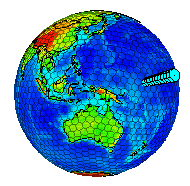
Despite significant progress in the Tropical Ocean-Global Atmosphere (TOGA) program, a number of major hurdles remain before the primary objective, prediction of the variability of the coupled ocean-atmosphere system on time scales of months to years, can be achieved. Foremost among these hurdles is understanding the physics that maintains and perturbs the western Pacific warm pool, the region of the warmest sea surface temperature in the open oceans, which coexists with the largest annual precipitation and latent heat release in the atmosphere. Even though it is believed that the warm pool is a "center of action" for the El Nino-Southern Oscillation (ENSO) phenomena in the ocean and the atmosphere, successful simulation of the warm pool has remained an elusive goal.
To gain a clear understanding of global climate change, the ENSO phenomenon, and the intraseasonal variability of the coupled atmosphere-ocean system, it is clear that a better specification of the coupling of the ocean and the atmosphere is required. An observational and modeling program, the TOGA Coupled Ocean-Atmosphere Response Experiment (TOGA COARE), has been designed to work toward this goal.
The scientific goals of COARE are to describe and understand:
1) the principal processes responsible for the coupling of the ocean and the
atmosphere in the western Pacific warm-pool system;
2) the principal atmospheric processes that organize convection in the warm-pool
region;
3) the oceanic response to combined buoyancy and wind-stress forcing in the
western Pacific warm-pool region; and
4) the multiple-scale interactions that extend the oceanic and atmospheric
influence of the western Pacific warm-pool system to other regions and vice
versa.
To carry out the goals of TOGA COARE, three components of a major field experiment have been defined: interface, atmospheric, and oceanographic. An intensive observation period (IOP), embedded in a period of enhanced meteorological and oceanographic monitoring, will occur from November 1992 through February 1993 in the western Pacific region bordered by 10 degrees N, 10 degrees S, 140 degrees E, and the date line. The experimental design calls for a complex set of oceanographic and meteorological observations from a variety of platforms that will carry out remote and in situ measurements. The focus of the observational effort will be in an intensive flux array (IFA) centered at 2 degrees S and 156 degrees E. The resulting high-quality dataset is required for the calculation of the interfacial fluxes of heat, momentum, and moisture, and to provide ground truth for a wide range of remotely sensed variables for the calibration of satellite-derived algorithms. The ultimate objective of the COARE dataset is to improve air-sea interaction and boundary-layer parameterizations in models of the ocean and the atmosphere, and to validate coupled models.
Webster, P.J. and Lukas, R. 1992:TOGA COARE: The Coupled Ocean-Atmosphere Response Experiment. Bull. Amer. Meteor. Soc., 73, 1377-1416
The data is contained in the following five files:
All data in these files represent an average over the COARE Intensive Flux Array (IFA). At the perimeters of the IFA polygon were four Integrated Sounding Sites (ISS): Kapingamarangi, Manus, R/V Shiyan 3 and R/V Kexue 1. The dates when the R/V ships were present are:Fields of geopotential height (z), zonal wind (u), meridional wind (v), temperature (T) and specific humidity (q) were objectively analyzed using multiquadric interpolation (Nuss and Titley 1994) over the Large Scale Array (LSA) of TOGA/COARE at 25 mb resolution from 1000 to 25 mb and at 1 degree resolution in both the latitude and longitude directions. Surface pressure (see note below) was also analyzed over the LSA. This analyses was done for 480 six hour intervals (00, 06, 12, and 18UTC) during the COARE Intensive Observing Period (IOP - 1 November, 1992 through 28 February, 1993).
Notes:
Line 1 contains: [year, month, day, hour]
                  written with format (4i3)
Lines 2-42 contain: [p(mb), z(m), u(m/s), v(m/s), omega(mb/hr), T(C), theta(K),
                          specific humidity(gr/kg) and divergence(1/s)*10e6]
                          written with format (9f.2)
Omega is computed using O'Brien's (1970) method with an isovalue adjustment.
Omega is set to zero at the surface and at 75 mb.
advect.ifa
File "advect.ifa" contains 480 periods of six-hourly data. For each six hour
period there are 42 lines of data.
Line 1 contains: [year, month, day, hour]
                 written with format (4i3)
Lines 2-42 contain: [p(mb), hu(m/s**2), vu(m/s**2), hv(m/s**2), vv(m/s**2),
                          hT(C/s), vT(C/s), hq(gr/(gr*s)), vq(gr/(gr*s))]
                          written with format (f8.2,1p,8e11.3)
                          where hu - horizontal advection of u
                          where vu -   vertical advection of u
                          where hv - horizontal advection of v
                          where vv -   vertical advection of v
                          where hT - horizontal advection of T
                          where vT -   vertical advection of T
                          where hq - horizontal advection of q
                          where vq -   vertical advection of q
These horizontal and vertical advection terms were computed using centered
differences as follows:
horizontal advection of "f": h(f) = u*df/dx + v*df/dy
                      where: dx = a cos(phi)*d(lambda)
                             dy = a d(phi)
                             phi    - latitiude
                             lambda - longitude
vertical advection of "f": v(f) = omega*df/dp
q1q2.ifa
Line 1 contains: [year, month, day, hour]
                 written with format (4i3)
Lines 2-41 contain: [p(mb), Q1(C/day), Q2(C/day)]
                          written with format (3f.2)
The apparent heat source, Q1, and moisture sink, Q2 (Yanai et al. 1973)
were computed as:
Q1/cp = [dT/dt + h(T) + (p/po)**kappa * omega * d(theta)/dp]
Q2/cp = -Lv/cp * [dq/dt + h(q) + v(q)]
      where dt = 12 hours
            po = 1000 mb
            cp = 1004
            Lv = 2.5e6
             g = 9.8
eopo.ifa
p_0 = e_0 + 1./(g*Lv) * [integral(Q2*dp) from 1000mb to 100mb]

Line 1-478 contains: [year, month, day, hour, e_0(mm/day), p_0(mm/day)]
                     written with format (4i3,2f8.2)
Line 479 contains the IOP average daily rainfall rate over the IFA
misc.ifa
[year, month, day, hour, IFA average brightness temp (C), IFA average SST(C),
IFA average sensible and latent heat flux (watt/(m*m)]
	written with format (4i5,4f8.2)
A sample line from this file is shown below:
1992 11 2 6 -11.80 29.52 4.03 91.45History of dataset changes
          omega = u*d(psfc)/dx + v*d(psfc)/dy
     to
          omega = 0.
06/18/96 Divergence and omega were corrected due to a slight error found
in implementation of the O'Brien adjustment scheme.06/18/96 Surface winds were corrected at R/V Shiyan 3 and R/V Kexue 1. Previous winds were off by about 12 degrees.
The 06/18/96 changes resulted in omega changes from the previous version of the analyses that were greater than 50% from the surface to 975 mb (where omegas are quite small), decreasing to less than 10% above 800 mb and to less than 1% above 500 mb.
07/06/96 Surface fields were corrected in files fields.ifa and advect.ifa on 11/09/92 at 12UTC due to some bad data that made it into the surface analyses on this day.
09/23/96 Date information was corrected in file misc.ifa. In the original version of the file the date associated with data at 00 UTC was incorrect.
11/13/96 Improved surface analyses by assuming that data were from surface only if the height of the observations were within 10 m of station height. Also, bad surface humidities were removed (i.e., specific humidities less than 10 g/kg). The impact of this latter improvement will be most noteable from 11/17/92 to 01/04/93 when surface humidities at Kapinga were often considered bad (i.e., too low). The main effect of these changes, of course, are to the surface data themselves. The overall effect was to increase the IOP IFA daily averaged rainfall (estimated from the Q2 budget) from 8.166 mm/day to 8.207 mm/day (or an increase of 0.041 mm/day).
References
Miller E.R. and A.C. Riddle, 1994. TOGA COARE integrated sounding system data report - Volume IA Revised Edition. Available from the TOGA-COARE International Project Office, UCAR, P.O. Box 3000, Boulder, CO 80307.
Nuss W.A. and D.W. Titley, 1994: Use of multiquadric interpolation for meteorological objective analysis. Mon. Wea. Rev., 22, 1611-1631.
O'Brien J.J., 1970: Alternative solutions to the classical vertical velocity problem. J. Appl. Meteor., 9, 197-203.
Weller, R.A., and S.P.,Anderson, 1996: Surface meteorology and air-sea fluxes in the western Pacific during the TOGA COARE. Accepted for publication in J. Climate.
Yanai, M.S., S. Esbensen and J.H. Chu, 1973: Determination of bulk properties of tropical cloud clusters form large-scale heat and moisture budgets. J. Atmos. Sci., 30, 611-627.