
|

|


Measuring weather
Surface observations - precipitation
 One of the weather's most tangible features is precipitation (rain, snow, hail,
etc.) Accurate observations are essential for hydrological, flood forecasting,
and for agriculture. Information about freezing precipitation is of particular
importance to airline pilots. Observations typically include information about
the type, intensity, and liquid-equivalent volume of precipitation. Amounts are
typically reported as inches or millimeters of water, with precision to about
a tenth of an inch.
Not all automated systems make precipitation measurements. When there is not
automated precipitation observations, manual measurements are made, usually with
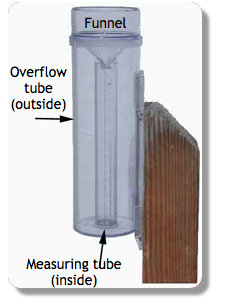
a standard 8-inch rain gauge like the one you see to the left. It consists of a
graduated cylinder with a funnel at the top set inside a larger cylinder. When
temperatures dip below freezing, the funnel and inner cylinder are removed to
collect frozen precipitation, like snow, which is periodically melted for
measurement.
Next page
->
in situ, surface observations, precipitation
One of the weather's most tangible features is precipitation (rain, snow, hail,
etc.) Accurate observations are essential for hydrological, flood forecasting,
and for agriculture. Information about freezing precipitation is of particular
importance to airline pilots. Observations typically include information about
the type, intensity, and liquid-equivalent volume of precipitation. Amounts are
typically reported as inches or millimeters of water, with precision to about
a tenth of an inch.
Not all automated systems make precipitation measurements. When there is not
automated precipitation observations, manual measurements are made, usually with
a standard 8-inch rain gauge like the one you see to the left. It consists of a
graduated cylinder with a funnel at the top set inside a larger cylinder. When
temperatures dip below freezing, the funnel and inner cylinder are removed to
collect frozen precipitation, like snow, which is periodically melted for
measurement.
Next page
->
in situ, surface observations, precipitation
Links and resources
Surface observations - precipitation
One of the weather's most tangible features is precipitation (rain, snow, hail,
etc.) Accurate observations are essential for hydrological, flood forecasting,
and for agriculture. Information about freezing precipitation is of particular
importance to airline pilots. Observations typically include information about
the type, intensity, and liquid-equivalent volume of precipitation. Amounts are
typically reported as inches or millimeters of water, with precision to about
a tenth of an inch.
Not all automated systems make precipitation measurements. When there is not
automated precipitation observations, manual measurements are made, usually with
a standard 8-inch rain gauge like the one you see to the left. It consists of a
graduated cylinder with a funnel at the top set inside a larger cylinder. When
temperatures dip below freezing, the funnel and inner cylinder are removed to
collect frozen precipitation, like snow, which is periodically melted for
measurement.
Next page
->
in situ, surface observations, precipitationLinks and resources
