
|

|


Measuring weather
Upper air measurements - radiosondes & rawinsondes
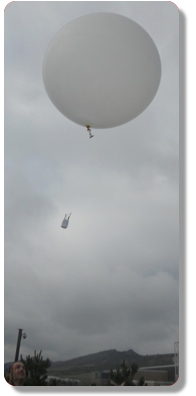 Radiosondes/rawinsondes are one of the most relied-upon upper air measurement
platforms in the world. In comparison to other possibilities, they are cheap,
reliable, and common. Radiosondes are small packages containing many
instruments. They measure atmospheric properties from the ground to heights of
approximately 18 to 25 miles. When launched, they rise at a steady rate of
ascent by a helium- or hydrogen-filled rubber balloon. Standard measurements
made by radiosondes are temperature, pressure, and humidity. When the
capability to obtain wind speed and direction measurements is added, the
radiosonde is called a rawinsonde. Additional instruments can be added
such as those for measuring chemical concentrations.
Radiosondes transmit data via radio signal from measurements obtained along a
sounding line. The trip that the balloon takes is called a sounding. As
the balloon rises, it expands in size as the air aloft becomes less dense,
growing from about 4-5 feet in diameter near the ground to 24-32 feet in
diameter when it finally pops and begins its descent. Because they may never
be found or survive the fall, radiosondes are expendable equipment.
Next page
->
in situ, upper air measurements, radiosondes & rawinsondes
Radiosondes/rawinsondes are one of the most relied-upon upper air measurement
platforms in the world. In comparison to other possibilities, they are cheap,
reliable, and common. Radiosondes are small packages containing many
instruments. They measure atmospheric properties from the ground to heights of
approximately 18 to 25 miles. When launched, they rise at a steady rate of
ascent by a helium- or hydrogen-filled rubber balloon. Standard measurements
made by radiosondes are temperature, pressure, and humidity. When the
capability to obtain wind speed and direction measurements is added, the
radiosonde is called a rawinsonde. Additional instruments can be added
such as those for measuring chemical concentrations.
Radiosondes transmit data via radio signal from measurements obtained along a
sounding line. The trip that the balloon takes is called a sounding. As
the balloon rises, it expands in size as the air aloft becomes less dense,
growing from about 4-5 feet in diameter near the ground to 24-32 feet in
diameter when it finally pops and begins its descent. Because they may never
be found or survive the fall, radiosondes are expendable equipment.
Next page
->
in situ, upper air measurements, radiosondes & rawinsondes
Links and resources
Upper air measurements - radiosondes & rawinsondes
Radiosondes/rawinsondes are one of the most relied-upon upper air measurement
platforms in the world. In comparison to other possibilities, they are cheap,
reliable, and common. Radiosondes are small packages containing many
instruments. They measure atmospheric properties from the ground to heights of
approximately 18 to 25 miles. When launched, they rise at a steady rate of
ascent by a helium- or hydrogen-filled rubber balloon. Standard measurements
made by radiosondes are temperature, pressure, and humidity. When the
capability to obtain wind speed and direction measurements is added, the
radiosonde is called a rawinsonde. Additional instruments can be added
such as those for measuring chemical concentrations.
Radiosondes transmit data via radio signal from measurements obtained along a
sounding line. The trip that the balloon takes is called a sounding. As
the balloon rises, it expands in size as the air aloft becomes less dense,
growing from about 4-5 feet in diameter near the ground to 24-32 feet in
diameter when it finally pops and begins its descent. Because they may never
be found or survive the fall, radiosondes are expendable equipment.
Next page
->
in situ, upper air measurements, radiosondes & rawinsondesLinks and resources
