
|

|


Measuring weather
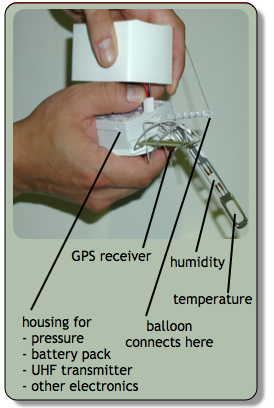 Let's look at an example of a radiosonde. The photo to the right is the Vaisala
RS92. This radiosonde is small enough to fit in your hand. Most of that size
is from a battery pack, insulation, and electronics. The measurement
instruments themselves are quite tiny. The temperature sensor is a platinum
wire encased in glass, a filament only a fraction of a millimeter wide. The
humidity sensor is polymer based, and the RS92 includes two of them, each 4 by
1.5 millimeters. The two humidity sensors alternate observation time and
heating time so that condensed water and ice that causes measurements errors can
be removed. The pressure sensor, measuring 3 by 2.5 millimeters is located
inside the white housing. It consists of a flexible diaphragm electrode sealing
off a vacuum chamber. As pressure changes, the distance and capacitance between
the diaphragm and a fixed base electrode changes. Wind direction and speed are
calculated by GPS measurements on the sonde and at the ground while the sonde
rises and is moved by the wind over time.
The RS92 is tethered 60 meters below the balloon during the ascent so that
measurements are not affected by the presence of the balloon. As measurements
are made, the data are radioed to the radio antenna at the ground and processed
and transferred to a computer for monitoring.
You can check out
this National Weather Service website for a tour of weather balloon launch
procedures!
Next page
->
in situ, upper air measurements, radiosondes & rawinsondes
Let's look at an example of a radiosonde. The photo to the right is the Vaisala
RS92. This radiosonde is small enough to fit in your hand. Most of that size
is from a battery pack, insulation, and electronics. The measurement
instruments themselves are quite tiny. The temperature sensor is a platinum
wire encased in glass, a filament only a fraction of a millimeter wide. The
humidity sensor is polymer based, and the RS92 includes two of them, each 4 by
1.5 millimeters. The two humidity sensors alternate observation time and
heating time so that condensed water and ice that causes measurements errors can
be removed. The pressure sensor, measuring 3 by 2.5 millimeters is located
inside the white housing. It consists of a flexible diaphragm electrode sealing
off a vacuum chamber. As pressure changes, the distance and capacitance between
the diaphragm and a fixed base electrode changes. Wind direction and speed are
calculated by GPS measurements on the sonde and at the ground while the sonde
rises and is moved by the wind over time.
The RS92 is tethered 60 meters below the balloon during the ascent so that
measurements are not affected by the presence of the balloon. As measurements
are made, the data are radioed to the radio antenna at the ground and processed
and transferred to a computer for monitoring.
You can check out
this National Weather Service website for a tour of weather balloon launch
procedures!
Next page
->
in situ, upper air measurements, radiosondes & rawinsondes
Links and resources
Let's look at an example of a radiosonde. The photo to the right is the Vaisala
RS92. This radiosonde is small enough to fit in your hand. Most of that size
is from a battery pack, insulation, and electronics. The measurement
instruments themselves are quite tiny. The temperature sensor is a platinum
wire encased in glass, a filament only a fraction of a millimeter wide. The
humidity sensor is polymer based, and the RS92 includes two of them, each 4 by
1.5 millimeters. The two humidity sensors alternate observation time and
heating time so that condensed water and ice that causes measurements errors can
be removed. The pressure sensor, measuring 3 by 2.5 millimeters is located
inside the white housing. It consists of a flexible diaphragm electrode sealing
off a vacuum chamber. As pressure changes, the distance and capacitance between
the diaphragm and a fixed base electrode changes. Wind direction and speed are
calculated by GPS measurements on the sonde and at the ground while the sonde
rises and is moved by the wind over time.
The RS92 is tethered 60 meters below the balloon during the ascent so that
measurements are not affected by the presence of the balloon. As measurements
are made, the data are radioed to the radio antenna at the ground and processed
and transferred to a computer for monitoring.
You can check out
this National Weather Service website for a tour of weather balloon launch
procedures!
Next page
->
in situ, upper air measurements, radiosondes & rawinsondesLinks and resources
